
Winter-Proof Your Outdoor Lighting: A UK Checklist for Porches, Paths and Patios
A practical UK guide to getting porch, path and patio lights through winter — IP ratings, seals, timers...

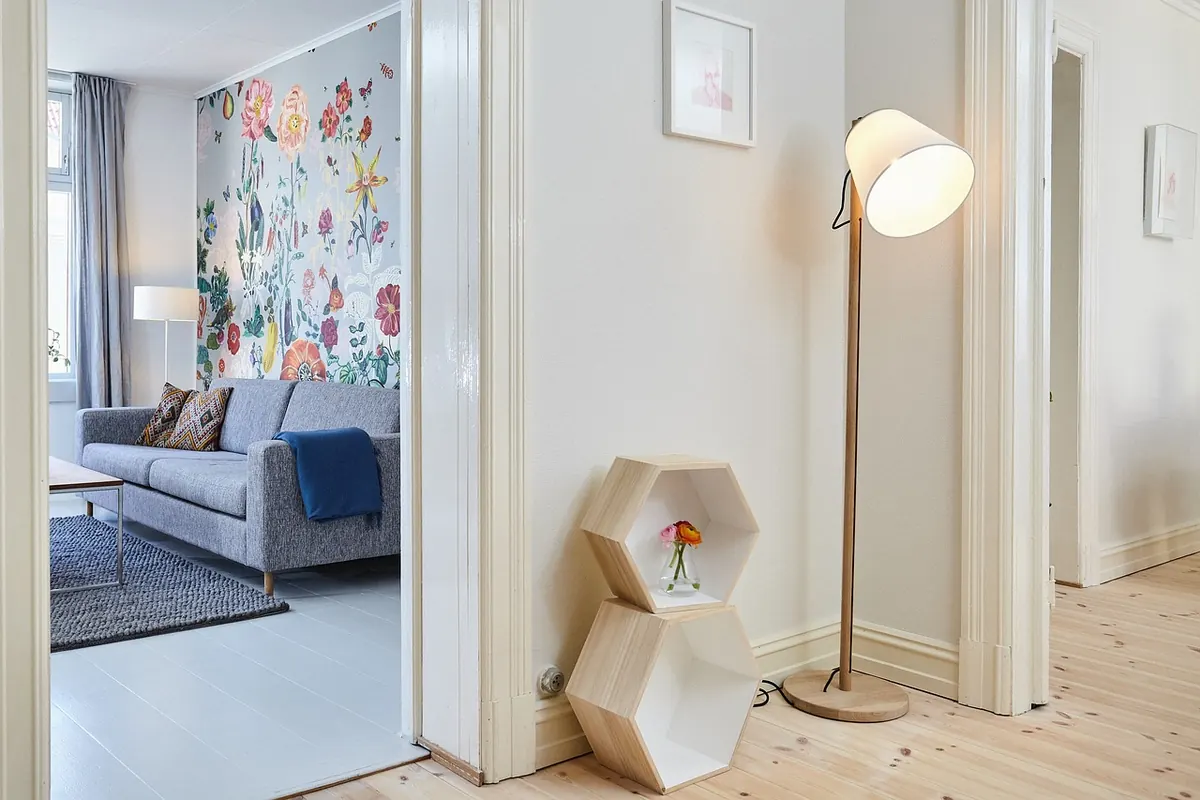
Most living rooms in the UK are lit by one fitting in the middle of the ceiling. It works, in the sense that you can see. But it flattens the room, casts shadows where you want to read, and gives you a single choice: bright or dark. Layering lighting is simply the habit of using several sources at different heights with different jobs, so the room can change through the evening without anyone crawling behind the sofa for a plug.
You do not need a rewiring project or a designer. Three or four well-placed fittings, chosen with a bit of thought, will do more for a living room than any single expensive light.
A pendant puts light above head height and points it straight down. Standing under it you get a pool of brightness; sitting beside it you get your own shadow across the book. Corners stay dim, and the light is exactly the same at 7am and 11pm, which is why so many rooms feel either clinical or gloomy.
Layering separates the jobs. One source lights the room overall, others light what you are doing, and others add depth and shape. That is the whole idea.
Your base layer — light that fills the room so you can move about comfortably. A pendant, a pair of ceiling spots or a large shaded floor lamp can all do this job. Aim for even, soft coverage rather than brilliance. Two or three sources at low output nearly always beat one bright one.
Directed at something you are doing: reading, knitting, writing, homework at the table. A floor lamp with an angled head beside an armchair, a slim table lamp on a side table, or a swing-arm wall light all work. The light should land on the page or your hands, not in your eyes.
Accent lighting is there to be looked at as much as to see by. It picks out a picture, a shelf of books, a plant, a textured wall. Picture lights, small uplighters behind a plant, a low lamp on a console, or a discreet LED strip under a shelf all count. This is the layer that makes a room feel like somewhere, rather than just somewhere to sit.
The fitting matters less than what you put in it. Warm white bulbs, around 2700K, suit living rooms; anything much cooler starts to feel like an office after dark. If you want a softer look, look for bulbs described as warm or extra warm — the label will give you the kelvin figure and the lumens.
Lumens tell you brightness; watts tell you consumption. A bulb of roughly 400 to 500 lumens is plenty for a table lamp, while a floor lamp carrying the ambient load will want more.
Dimming is the biggest single upgrade to a layered scheme, because it lets the same fittings behave differently at 6pm and 10pm. Check two things before buying: that the bulb is marked dimmable, and that your dimmer switch suits the bulb type. Some older dimmers and LED bulbs disagree with each other, producing flicker or a faint buzz. If in doubt, replace the switch at the same time as the bulbs, and use an electrician for anything beyond a straightforward swap.
Buying matching lamps for symmetry and then having no flexibility. Running everything from one switch, so the room is either all on or all off. Choosing bulbs by wattage alone and ending up with a cold, glaring light. Putting a reading lamp behind your shoulder, so your own shadow falls across the page. Forgetting the corners — a dark corner behind a sofa undoes a lot of good work elsewhere.
The fixes are usually small: move the lamp forward, drop it a few centimetres, add one low source in the corner that bothers you most.
Pick one seat, probably the chair you read in most, and give it proper task light. Then add one low accent lamp across the room from it. Turn the ceiling light down, or leave it off altogether, and see how the room feels at nine in the evening. Most people find they keep the main light switched off from then on.
From there the scheme grows naturally: a picture light over a favourite print, a second floor lamp in the corner, a dimmer on the main circuit. Layer by layer, the room becomes somewhere you want to sit once the curtains are closed — which is, after all, the point of a living room.
Photo: StockSnap / Pixabay
A practical UK guide to getting porch, path and patio lights through winter — IP ratings, seals, timers...
A practical checklist for lighting a child's bedroom well — covering safety, night lights,...
Confused by smart bulbs? Here's how hubs, apps, voice control, dimming and UK fittings such as B22 and...