
Winter-Proof Your Outdoor Lighting: A UK Checklist for Porches, Paths and Patios
A practical UK guide to getting porch, path and patio lights through winter — IP ratings, seals, timers...

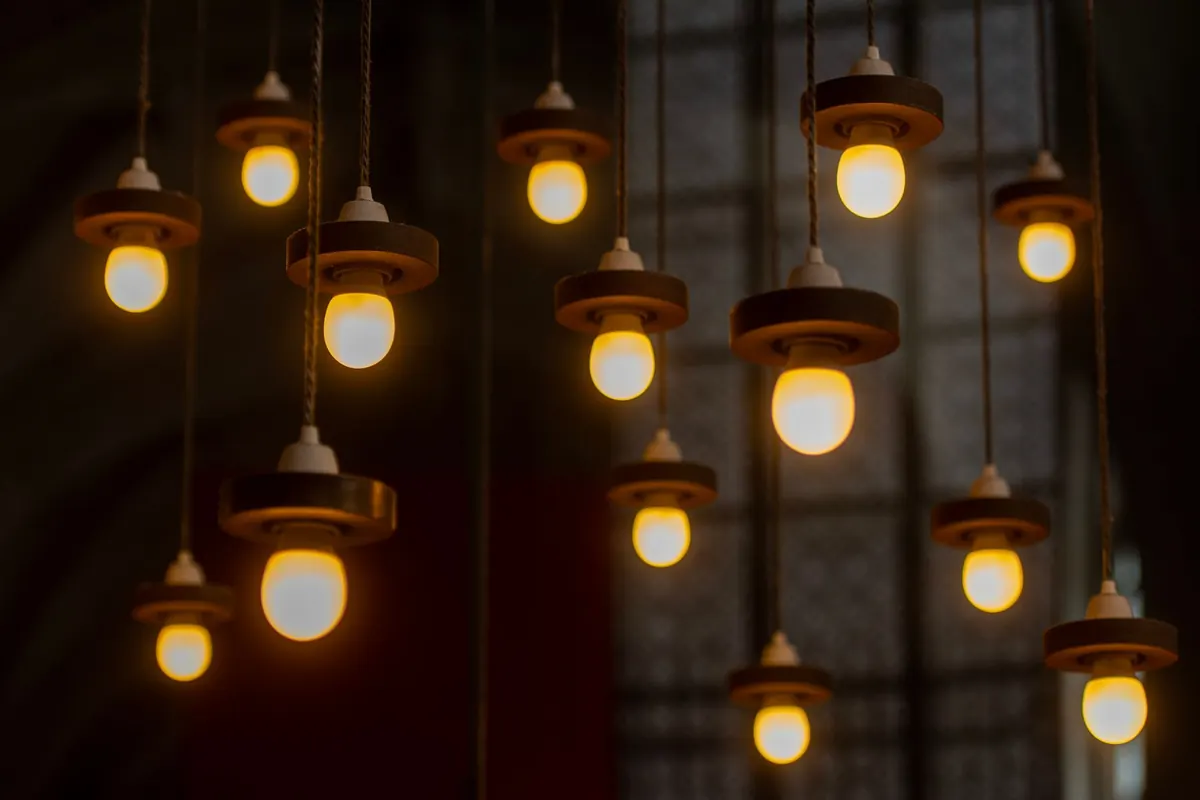
Stand in the bulb aisle of any DIY shop and you will see two boxes that look almost identical. One says warm white, the other cool white. Both fit the same bayonet cap, both claim to be bright, and only one of them will look right in your living room. The difference comes down to colour temperature, measured in kelvin — one of the most useful numbers on the packaging, and one most of us walk straight past.
Kelvin describes the colour of the light, not how much of it you get. Counter-intuitively, the lower the number, the warmer the glow. An old-fashioned incandescent bulb sat at roughly 2700K, which is why that amber tone feels familiar and comfortable. As the number climbs, the light turns crisper and eventually takes on a blue cast.
Brightness is a separate figure: lumens. A 2700K bulb and a 4000K bulb with the same lumen output are equally bright — they simply feel different. Also worth a glance is the colour rendering index (CRI, sometimes shown as Ra). The higher the number, the truer colours look under it; 80 and above is decent for a home, and 90+ is worth having beside a bathroom mirror or over a kitchen worktop.
Treat 2700K as the starting point for a living room. It flatters wood, wool, fabric and skin tones, and it works with the lower light levels you want in the evening. A single 2700K ceiling fitting will do the job, but most rooms look better with two or three sources: a floor lamp beside an armchair, a table lamp on a sideboard, a wall light in a dark corner. Keep them all in the same warm register.
If your main light is dimmable, so much the better. Dimming a warm bulb makes a room feel calmer rather than merely darker. Some LED bulbs now shift warmer as they dim — sold as "warm dim" or "dim to warm" — which mimics how old halogens behaved. If you already have a dimmer switch, check whether it is LED-compatible before buying, or the bulb may flicker or buzz.
Cool white is a hard sell in a living room. At 4000K, grey sofas look greyer, timber looks flat, and the whole space reads as slightly clinical after dark. If you need sharper light for a hobby — needlework, model-making, small print — use a dedicated task lamp rather than lifting the temperature of the entire room.
Kitchens are where a cooler white starts to make sense. You are chopping, reading labels and checking whether chicken is cooked through, and crisp light helps. Under-cabinet strips and worktop downlights at 4000K give clean, even illumination across a surface. Watch the glare, though: a bare cool bulb bouncing off a glossy splashback is unpleasant to work under.
The real mistake is mixing registers within one sightline. If a 4000K downlight washes the worktop while a 2700K pendant hangs over the island, the difference will be obvious, and not in a good way. Pick one temperature for the room — 3000K is a comfortable compromise where a kitchen opens onto a living area — and use additional fittings, not different colours, to build the layers.
Bedrooms want the lowest numbers in the house: 2700K as standard, 2200K for anything beside the bed. Bright, cool light in the evening feels alerting, and plenty of people find it harder to settle with a 4000K ceiling light blazing above them. Warm, low-level light is simply easier to wind down in.
In practice, that means a dimmable ceiling fitting and bedside lamps with warm bulbs, ideally on separate switches so one person can read while the other sleeps. A 2700K lamp under a fabric shade throws a soft pool of light; a bare cool-white bulb on a bedside table does the opposite. If you read in bed, a warm bulb at slightly higher output in an angled lamp beats a cool one at low output.
Bathrooms rarely suit a single temperature. Around the mirror, where you shave, apply make-up or check your teeth, 4000K gives the clearest view and the least colour distortion. For general ambient light, 2700–3000K is kinder early in the morning and late at night. Two circuits — one for the mirror, one for the ceiling — let you choose which you want.
Position matters as much as kelvin. A single light above the mirror casts shadows under the eyes and nose; light from either side at face height is far more flattering and more useful. Because bathrooms are damp, fittings need an appropriate IP rating for the zone they sit in. If you are unsure which zone applies where, or you are adding new circuits, ask a qualified electrician rather than guessing.
Three rooms people usually forget. Hallways and stairs work well at 3000K — warm enough to feel welcoming, bright enough to show the edge of each step. Keep hall lights consistent with the rooms they lead into, so you are not stepping from amber into blue as you cross the threshold.
Home offices are the swing case. A 4000K desk lamp keeps you alert through a working day; if the room doubles as an evening study or hobby space, use 3000K overhead and keep the cooler light local to the desk.
A few rules keep a mixed scheme looking deliberate rather than accidental:
One last note on the box: wattage tells you how much power a bulb uses, which matters far less now that LEDs are so efficient. Lumens tell you how bright it is. Kelvin tells you how it will feel. Read those two numbers and you will rarely go wrong.
If you would rather not think about it again, do this. Choose 2700K for living rooms, bedrooms, hallways and dining rooms. Choose 4000K for kitchens, bathrooms and anywhere you need to see fine detail. Use 3000K as the bridge when a kitchen opens onto a living space.
Then buy one bulb, fit it, and live with it for an evening before committing to six more. Check the cap — B22 bayonet and E27 Edison screw cover most UK fittings, while downlights usually take GU10 — and note the lumens so you can repeat the result. Keep the packaging and the receipt. A colour temperature you dislike is much easier to swap when there is only one of them.
Photo: Jan van der Wolf / Pexels
A practical UK guide to getting porch, path and patio lights through winter — IP ratings, seals, timers...
A practical checklist for lighting a child's bedroom well — covering safety, night lights,...
Confused by smart bulbs? Here's how hubs, apps, voice control, dimming and UK fittings such as B22 and...